Two gates, one after the other
Production access: what Google is checking, and how to answer for it
Production access is not a reward for finishing 14 days. It is a review that happens after the 14 days, and it is the only step in this process where a person reads what you wrote and decides. Getting there with good data is half the job; describing that data honestly and specifically is the other half.
This page covers the process itself. If you have not started the window yet, the closed testing explainer is the better starting point.
The two gates, and why people confuse them
Most rejection anxiety comes from treating these as one step. They are separate, they are judged differently, and they fail for different reasons.
Gate one
Days 0 to 14
Closed testing
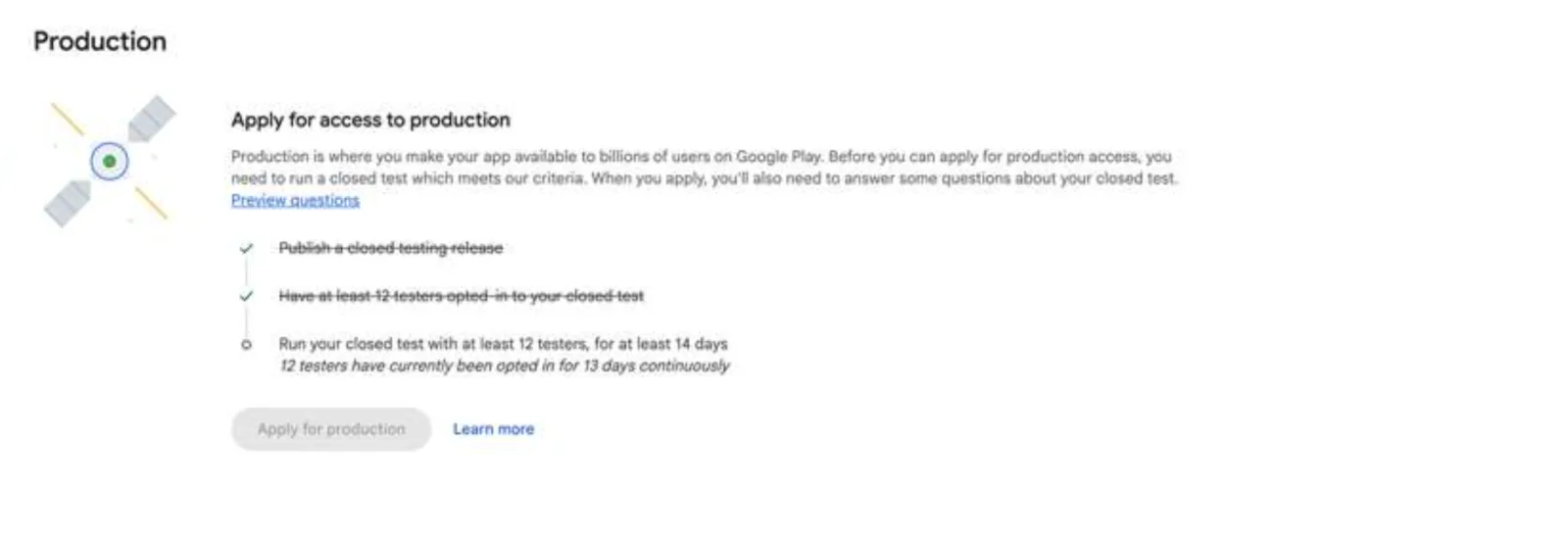
A build live on your closed track with at least 12 testers opted in for 14 continuous days. Nobody approves this stage — it is a condition Play Console evaluates, and clearing it opens the application rather than the release.
Fails when the count dips below 12, when testers install without using the app, or when the track is paused.
Gate two
After day 14
Production access application
A written application plus Google's questionnaire. A reviewer reads your answers against the testing data they can already see. This gate is evaluated by a human being, and it can come back as a rejection with a reason.
Fails when answers are vague, when they contradict the telemetry, or when there is no evidence of changes made in response to feedback.
What is the questionnaire actually asking?
The form looks longer than it is. Strip the phrasing and it wants four things, and each one is something a well-run 14-day window already produced. The exact question count and wording change between accounts, so treat this as the structure rather than a transcript.
How you recruited testers
Asks Where the 12 people came from and whether they were real users or a favour from friends and family.
Works A specific, checkable answer. Some developers name the community or service they used. Vague answers like "I asked around" read as a group that was assembled once and forgotten.
What feedback you collected
Asks What testers told you, in enough detail that a reviewer can tell you actually read it.
Works Two or three concrete themes with the bug or friction point behind each one. This is where an archived tester log pays for itself — it is the difference between recalling feedback and quoting it.
What you changed as a result
Asks Which problems you fixed and which release carries the fix.
Works A version note or release history that lines up with your answer. Applications look strongest when the claim in the questionnaire is visible in the build history.
Why the app belongs in production
Asks A justification that your app is ready for general users rather than a beta audience.
Works The boring one: state what the app does, who it is for, and that the testing period surfaced and resolved issues. Reviewers are not looking for persuasive copy.
There is a full walkthrough of the submission itself in our guide to applying for production access.
Data from 1,500+ campaigns analyzed
Why do applications get rejected?
Reason 1
Engagement that does not hold up
The most common cause by a wide margin. Testers opted in, the count stayed above 12, and the usage record is thin — installs with few return visits. Nothing in the questionnaire can repair this, because the reviewer sees the same data you cannot hide.
What to do instead
Run a second cycle with a group committed to daily use. Testers active on 10 or more days approve at 97% in our data, against 41% at 5-7 days.
Reason 2
Answers that contradict the data
Claiming you shipped fixes when the track shows one release, or describing feedback that no tester could have given. Reviewers compare the application against the track history.
What to do instead
Answer from your actual release notes and tester reports. If the window was quiet, say what you did and be specific about the smaller fixes.
Reason 3
Answers that say nothing
Copy-pasted guidance from a forum thread, or three sentences spread across twenty questions. This reads as an application assembled to satisfy a form rather than describe a test.
What to do instead
Write short, direct answers with a specific detail in each. Two sentences with a real example beat a paragraph of generalities.
72%
first-attempt approval across all campaigns we have analyzed — including the ones that cut corners on engagement. This is not a target; it is the average.
91%
approval on the second attempt, for developers who address the reason Google gave in the rejection. A rejection is a delay, not a dead end.
Rejected already? The path back
A rejection notice names a reason. Read it twice before doing anything, because the fix depends entirely on which reason you got. Most developers who are rejected for engagement assume the answer is more testers, and run the same cycle again with 15 people who behave exactly like the first 12.
The recovery sequence we recommend, in order: identify which of the three reasons applies, run a fresh 14 days that specifically produces evidence against that reason, then rewrite the questionnaire answers from the new data rather than editing the old ones. Developers who follow that sequence pass at 91% in our data.
The detailed breakdown of rejection notices and what each one means is in our production access rejection guide.
Who does not need any of this
- Organization accounts verified with a D-U-N-S number — the requirement does not apply.
- Personal accounts created before 13 November 2023.
- Accounts that already have an app approved and live in production.
Check your status in Play Console before buying anything. The per-app breakdown covers the cases where one account has mixed obligations.
Where we come in
We supply the 14 days and the evidence: tester activity records, bug reports, and the feedback themes that questionnaire answers are built from. You write the submission and own the account. If Google refuses production access for tester engagement, we refund the fee.
See what the cycle includesWhat should you have ready before you apply?
The application is easier to write when the material already exists. Four things gathered before day fourteen turn the questionnaire into a transcription exercise instead of a memory test.
01Release history
Every version you pushed to the closed track, with the date and a one-line note on what changed. This is the evidence behind the "what did you change" question, and it has to match what the track shows. If your answers describe fixes that no release contains, a reviewer sees the mismatch immediately.
02Tester feedback in the original
The raw reports and messages rather than your own summary of them. Specifics you can quote — the device, the flow, the symptom, what the tester expected — are what separate an answer written from a real test from one written in a hurry.
03Fixed versus deferred
A list of what you resolved and what you deliberately left. Reviewers do not expect every report to be closed out. They expect to see that reports were read, triaged, and acted on where it mattered.
04Your own words for the app
A short, plain description of what the app does and who it is for. It sounds trivial and it is the answer people most often overthink, filling a sentence with keywords instead of saying what the product is.
Gathering all four is the main reason a cycle run with a managed service produces better answers than one run alone. Not because the questions are easier, but because the raw material is sitting in a dashboard rather than scattered across chats you stopped reading in week two.
Production access, answered directly
The questions that decide whether developers book a cycle or wait another month.
When can I apply for production access?
After completing 14 consecutive days of closed testing with at least 12 opted-in testers. The application includes Google's questionnaire, which asks how you recruited testers, what feedback you received, what you changed, and why the app is ready for general users.
What does the production access questionnaire ask?
The wording and question count vary by account, but the structure reduces to four themes: how your testers were recruited, what feedback they gave, which problems you fixed and in which release, and why the app is ready for production. Concrete, specific answers are what reviewers respond to.
Why do applications get rejected after completing 14 days?
Engagement that does not hold up is the most common cause — testers opted in but the usage record is thin. The second is answers that contradict the track history, such as claiming fixes that no release contains. The third is answers so vague they describe nothing.
What is the approval rate for a second attempt?
In our campaign data, 91% of developers who address the specific reason Google cited pass on the second attempt. The recovery sequence that works is identifying which reason applies, running a fresh cycle that produces evidence against it, then rewriting the answers from the new data.
Do organization accounts need production access review?
Organization accounts verified with a D-U-N-S number are not subject to the closed testing requirement and can apply for production after initial app review. Personal accounts created before 13 November 2023, and accounts with an app already live in production, are also outside the requirement.
Can OnTesters guarantee production access approval?
No, and no service can. Google reviews each application individually. What we provide is the 14-day window with tracked engagement, bug reports, and feedback themes that questionnaire answers are built from. If production access is refused for tester engagement reasons, we refund the fee.

Written and maintained by
Afrin Asha
Founder, OnTesters
Android developer and QA specialist. Built OnTesters after working through Google Play’s 12-tester closed testing requirement on real devices.
Platform figures on this page come from campaigns run through OnTesters. Read how the platform works or see the guides library.
Sources
- App testing requirements for new personal developer accounts— the requirement that gates production access
- Set up an open, closed, or internal test— track setup and the feedback obligations attached to closed testing
- Device verification requirements for new developer accounts— account-level checks that run in parallel
The 72% first-attempt and 91% second-attempt figures are OnTesters platform data from 1,500+ analyzed campaigns. Google does not publish approval rates, and we are not presenting ours as one.
Policy and pricing reviewed September 2026
Walk into the review with evidence
Fourteen days of tracked tester activity, bug reports with reproduction steps, and feedback themes you can quote. That is what the questionnaire is asking you to describe.