Google Play policy
Google Play closed testing, explained without the folklore
Closed testing is a release track, not a marketing exercise. You publish a build to a group of invited testers, Google reviews that release, and once the track is live those testers install through an opt-in link. For personal developer accounts created from 13 November 2023 onward, sitting in that track with 12 opted-in testers for 14 consecutive days is what unlocks the production access application.
Everything below comes from three places: Google's own documentation, the 1,500+ campaigns we have run or reviewed, and the developer threads where the confusion actually lives. Sources are listed at the bottom.
Who it applies to
Personal developer accounts created on or after 13 November 2023. Organization accounts verified with a D-U-N-S number are not subject to it.
Tester minimum
12 testers opted in through your closed track, continuously. Not 12 installs over the period — 12 in the group at any point in it.
Duration
14 consecutive calendar days. Weekends and holidays are included; the window cannot be paused or split.
Track
Closed testing only. Internal testing does not count towards the requirement and does not unlock production.
What it unlocks
Eligibility to apply for production access — not production access itself. Clearing the count opens the application, which Google reviews separately.
Reviewed separately
How testers engaged, what feedback you gathered, and what you changed as a result. Engagement is asked about at review; Google publishes no daily-open, session-length or screen-count quota.
Two stages, and why most advice on this topic conflates them
Almost every disagreement about closed testing comes from collapsing two separate stages into one. Keeping them apart is the difference between waiting the right number of days and waiting twice.
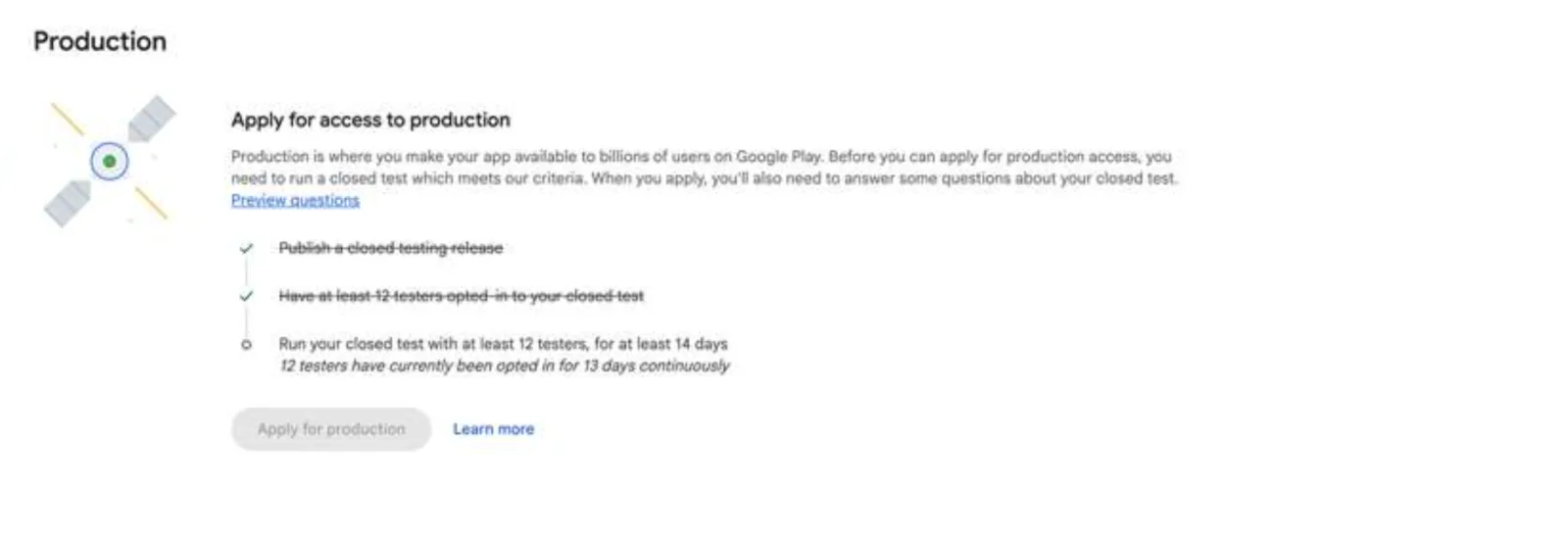
Your eligibility date is set by your twelfth tester
There is no single countdown for the app. Each tester carries their own unbroken opt-in history, so you become eligible when at least 12 of them have each completed the full period — not 14 days after you sent the first invitation. Testers rarely join on the same day, and that gap is the most common reason developers miss the date they were expecting.
A single opt-out moves the date again, because the interrupted stretch cannot be added to a later one. This is the practical argument for running above the minimum, which is what our 2-3 tester buffer exists to absorb.
Dates that get merged, and should not be
- 9 Nov 2023
- Google announced the testing requirement was coming. This is an announcement date, not the rule.
- 13 Nov 2023
- The account-creation cutoff that actually decides whether the requirement applies to you. An account created in the four-day gap between these two dates still falls inside it.
- 11 Dec 2024
- The tester minimum was reduced from 20 to 12. Pages still citing 20 are quoting a rule that no longer exists.
Three different facts that get quoted as one. If a page gives you a single date, it is worth checking which of these it means.
Why does Google require closed testing at all?
Before this policy, a developer account could be created on a Friday and publish to production on Saturday. That produced a specific and expensive class of app: functional enough to pass automated review, never opened by a human, and abandoned a week after download. Those apps filled the store with listings that looked live but had never once been used by anyone except the person who built them.
Closed testing is Google's filter for that pattern. It costs nothing to set up and cannot be automated away, because the signal being measured is human use over time. The count was originally 20 testers, which developers argued was arbitrary given that 12 was the figure Google's own research pointed at, and Google lowered it to 12. The principle did not change: someone other than you has to actually use the thing.
The practical consequence is that the requirement is not about numbers so much as about behaviour. A developer who finds 12 strangers on a swap thread and gets 12 same-day installs has satisfied the count and failed the test. A developer who finds 12 testers who open the app on 11 of the 14 days has done something much closer to what the policy was written to detect.
We wrote a longer breakdown of what a tester has to do to be counted in our article on tester eligibility, including the cases developers get wrong most often.
Which track do you actually need?
Play Console gives you three testing tracks and only one of them counts. The names are similar enough that people set up internal testing, wait two weeks, and then discover nothing was being measured.
| Track | Who can join | Google review | Counts toward the 12 | What it is for |
|---|---|---|---|---|
| Internal testing | Up to 100 people you invite by email | No Google review | No | Smoke-testing a build before anyone external sees it |
| Closed testing | Invite-only via email list or Google Group | Google reviews the first release | Yes | Satisfying the requirement and collecting structured feedback |
| Open testing | Anyone who finds the listing on Google Play | Google reviews the release | No | A public beta once production access is granted |
A common variant of this mistake: running closed testing on a different track entirely and assuming the two periods stack. They do not. The internal testing question gets asked often enough that we wrote it up separately.
What resets or stalls the 14-day window?
Four things account for nearly every preventable delay we see. None of them are mysterious, and all four are avoidable with a group you are actively managing.
The opted-in count falls below 12
Published conditionOpting out is the documented way a tester's continuous period ends, and it cannot be stitched back together — the days before the opt-out do not combine with the days after it. If the count drops below 12, the condition Google publishes is no longer met at the moment you apply.
Testers install and disappear
Our observationThis does not break the published count. It leaves you with nothing to report when the application asks how your testers engaged and what feedback you gathered — which is why we treat it as the highest-risk pattern in a campaign rather than a technicality.
The track is halted or testers are made to re-opt-in
InferenceAnything that interrupts opt-in continuity works against you, because the condition is evaluated over the most recent 14 days rather than banked from earlier. Ship updates to the same track instead of tearing it down and rebuilding it — an update does not restart the window.
The account is the wrong type for the exemption it claims
Published scopeGoogle documents the requirement against personal accounts, which is not the same sentence as "organization accounts are exempt". Developers who register as an organization to claim the exemption without completing verification can end up still inside the requirement, with paperwork pending.
Data from 1,500+ campaigns analyzed
What actually separates approvals from rejections?
Across all campaigns we have analyzed — including teams that recruited testers themselves and cut corners on engagement — first-attempt approval sits at 72%. The split inside that figure is the interesting part.
97%
Testers active on 10 or more days
The group behaves like real users. This is the single strongest predictor we have.
41%
Testers active on only 5-7 days
Half-hearted engagement is worse than a smaller, committed group. The installs are there; the sessions are not.
89%
Two or more updates shipped during the window
Shipping fixes produces the evidence the application asks you to describe, and our campaigns that shipped twice or more approve far more often. That correlation is ours; Google publishes no release count.
53%
Zero updates shipped during the window
A build that never changed across 14 days leaves nothing to report back as a response to feedback.
These are our own platform figures, not a Google statistic. They cover campaigns where the tester count was met, which is why none of the outcomes here are zero — the requirement was satisfied in every case, and the variation is entirely in how the testers behaved.
Where a managed service fits — and where it does not
What OnTesters handles
- Recruiting and verifying testers on physical Android hardware — Samsung, Pixel, Xiaomi, OnePlus — across 80+ countries and Android 11 through 15.
- Matching within 6 to 24 hours of receiving a valid opt-in link, so the count reaches 12 quickly and the 14 days start.
- Daily engagement monitoring, a buffer above the minimum, and free replacement for any tester who drops out.
What stays yours
- The Play Console account, the release build, and the signing key. We never ask for credentials or source code.
- The production access application itself, including the questionnaire answers. We supply your tester feedback and bug reports as raw material; you write the submission.
- The decision. Google reviews each application, and nobody — us included — can promise the outcome. Any service that guarantees approval is telling you something untrue.
What we do commit to is a refund if production access is refused for tester engagement reasons. The full process sits on the production access page.
Closed testing questions we get every week
Short answers to the parts developers ask about most. Each one links back to the policy or to our campaign data.
What is Google Play closed testing?
Closed testing is a Google Play release track where an invited group of testers installs your app through an opt-in link. Google reviews the first release on the track, and testers join via an email list or Google Group. For personal developer accounts created on or after 13 November 2023, the closed testing track is also the only track that satisfies Google's 12-tester, 14-consecutive-day requirement for production access.
How many testers do I need for closed testing?
At least 12 testers opted in continuously for 14 consecutive calendar days. The requirement is about the group staying above 12 across the whole window, not about accumulating 12 installs. We provision 14 or 15 testers so the count never dips below the floor if someone uninstalls or opts out.
Does internal testing count towards the 12 testers?
No. Internal testing is for up to 100 people you invite directly, requires no Google review, and does not count towards the closed testing requirement or unlock production access. Only the closed testing track satisfies the policy.
What causes the 14-day clock to reset or stall?
The opted-in count falling below 12 at any point, testers who install but never open the app, pausing the track, or forcing testers to re-opt-in. There is also a common account mistake: registering as an organization to claim the exemption without completing organization verification, which leaves the requirement in force while the paperwork is pending.
Do testers need to use the app every day?
Google evaluates sustained engagement rather than installs, so testers who open the app once and never return do not register as use. In our campaign data, testers active on 10 or more days correlate with a 97% approval rate, against 41% when testers are active on only 5-7 days.
Can I ship updates during the 14-day closed testing period?
Yes, and it is worth doing. Updates pushed to the same closed track reach testers without re-opting in, and shipping two or more updates during the window correlates with an 89% approval rate in our data, against 53% for a window with no updates.

Written and maintained by
Afrin Asha
Founder, OnTesters
Android developer and QA specialist. Built OnTesters after working through Google Play’s 12-tester closed testing requirement on real devices.
Platform figures on this page come from campaigns run through OnTesters. Read how the platform works or see the guides library.
Sources
- App testing requirements for new personal developer accounts— the policy of record
- Set up an open, closed, or internal test— track behaviour and opt-in flow
- Device verification requirements for new developer accounts— the account checks that run alongside this
- Google Play community guide on the tester-count change— community documentation of the drop from 20 testers to 12
Platform figures (72% first-attempt approval across all campaigns, 91% on the second attempt, and the engagement correlations) come from OnTesters campaign data covering 1,500+ analyzed campaigns. They are our observations, not Google policy.
Policy and pricing reviewed September 2026
Ready to start the 14 days?
Send us your closed testing opt-in link and we will have 12 verified testers on real devices within 24 hours, with a buffer above the minimum and free replacements if anyone goes quiet.